
This article makes the case that Acceptance Test-Driven Development (ATDD) is not a relic of agile ceremonies past, it is, in fact, the most important engineering discipline for the AI-assisted era we have just entered. If you care about building software that genuinely does what the business needs it to do, read on.
What Is ATDD?
Acceptance Test-Driven Development is a collaborative practice in which acceptance tests are written before any implementation begins, and those tests are expressed in the language of the business rather than the language of code.
Where TDD asks "does this method do what I wrote it to do?", ATDD asks "does this system do what the user needs it to do?"
The acceptance test becomes the single shared definition of done, agreed upon by developers, testers, and business stakeholders before a single line of production code is written. Done is no longer a matter of opinion. It is a passing test.
In practice, ATDD is most commonly expressed using the Given-When-Then syntax popularised by the Gherkin language:
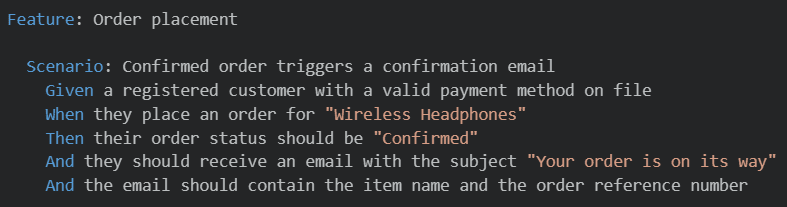
This scenario is readable by anyone in the organisation. It is unambiguous. It is executable. And it was written before the OrderService, EmailService, or PaymentGateway were touched. That is the discipline of ATDD.
A Brief History and Why It Fell Out of Fashion
ATDD emerged from the Extreme Programming (XP) movement in the early 2000s, with tools like FitNesse making it possible to write business-readable tests that executed against real code. Behaviour-Driven Development (BDD), popularised by Dan North around 2006, brought the Given-When-Then syntax and tools like Cucumber that made ATDD approachable at scale.
Yet over the following decade, many teams quietly abandoned it. The reasons were legitimate:
- Gherkin scenarios became verbose and unmaintainable at volume.
- Business stakeholders rarely wrote or even read the scenarios after the first sprint.
- Test suites became slow as they grew to cover every edge case.
- Teams treated every unit test as an acceptance test and vice versa, creating confusion.
The result was that ATDD was often dismissed as overhead. Teams doubled down on unit tests with mocks and shipped faster — at least on the surface.
What they lost in the process was the thing ATDD provides that nothing else does: a living, executable specification of what the system is supposed to do, owned jointly by the business and the engineering team.
The Three Amigos: The Human Practice Behind the Tool
ATDD is not primarily a testing tool — it is a communication practice. At its heart is a ritual known as the Three Amigos meeting: a focused, short conversation between a Business Analyst (representing the what), a Developer (representing the how), and a Tester (representing the what-could-go-wrong).
Before any story is developed, these three perspectives meet to define the acceptance criteria. The output is not a document — it is an executable scenario. This conversation surfaces misunderstandings that would otherwise become bugs. It aligns the team around intent, not assumption. And it produces a test that will live in the codebase long after the sprint ends.
The Three Amigos is where ATDD generates most of its value. The tooling simply preserves and automates what the conversation produced.
Is BDD the Same as ATDD? Clarifying a Common Confusion
At this point, an obvious question arises, because the Given-When-Then scenario above is exactly what most people associate with Behaviour-Driven Development. So are ATDD and BDD simply two names for the same thing? Not quite — and the distinction is worth holding onto.
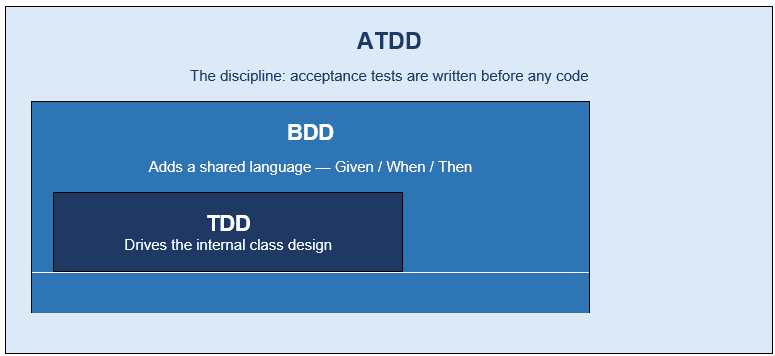
ATDD is a process discipline. It is the rule that acceptance tests must exist, and must be agreed upon, before coding begins. It says nothing about what language or syntax those tests must use.
BDD is a communication and design discipline. It specifies how behaviour should be described using a shared, structured, plain-language vocabulary (Given-When-Then) so that business and engineering are provably talking about the same thing.
This relationship can be visualised as three concentric layers, where each layer wraps around — and depends on — the one inside it.
Side by Side: TDD, BDD, and ATDD
Dimension | TDD | BDD | ATDD |
Primary question | Does this class work correctly? | Are we describing behaviour in language everyone shares? | Does this feature behave correctly, end to end? |
Written by | Developer | Developer, tester, and business analyst together | Developer, tester, and business analyst together |
Test boundary | A single class or method | A behaviour, often spanning classes | A vertical slice of the system |
Language | Code | Structured plain language (Given-When-Then) | Business language, format flexible |
Mocking strategy | Heavy. Isolate every dependency | Minimal. Real collaborators participate | Minimal. Only true infrastructure is faked |
Core artefact | Unit test | Behaviour scenario | Acceptance test (any format) |
Typical tooling | JUnit, NUnit, xUnit, Jest | Cucumber, SpecFlow, Behave, JBehave | Any test framework; often the same as BDD |
What ATDD Tests and What It Doesn't
A common mistake is treating ATDD as a replacement for all other testing. It is not. ATDD sits at a specific layer of the test pyramid, and its power comes from being used at the right layer.
ATDD acceptance tests cover:
- Core business behaviours and user journeys (the happy path)
- Key business rules that define the product (pricing logic, eligibility criteria, state transitions)
- Cross-cutting flows where multiple components must collaborate correctly
Unit tests (TDD) still own:
- Complex algorithms and calculations
- Edge cases, error handling, and boundary conditions
- Pure domain logic that benefits from exhaustive permutation testing
ATDD does not replace:
- Security and penetration testing
- Performance and load testing
- Exploratory testing
- Infrastructure and configuration validation
ATDD and Architecture: The Hexagonal Connection
Adopting ATDD seriously will push your architecture in a specific and healthy direction. When your tests exercise real domain objects instead of mocking them, your design is exposed in ways that unit tests with mocks never reveal.
Classes with too many responsibilities become hard to include in a scenario because they do too much. Anemic domain models become obvious because the test needs to orchestrate five service calls to achieve one business outcome. Tight coupling to infrastructure bleeds into the test setup and makes scenarios brittle.
The natural response to these pressures is the Hexagonal Architecture (Ports and Adapters) pattern. In a hexagonal architecture, your domain core has no dependencies on infrastructure. Adapters connect the domain to databases, APIs, and UIs through defined ports. ATDD tests live at the domain boundary, exercising real business logic while substituting lightweight in-memory adapters for infrastructure.
The result is a codebase that is simultaneously well-tested and well-designed, because the tests create pressure toward good design from day one.
Why ATDD Has Become Critical in the Age of AI
This is the conversation the industry needs to have urgently, and few are having it.
1. AI generates code at a pace that outstrips human comprehension
When a developer writes code, there is inherent friction — the time it takes to think and type — that creates natural checkpoints for reflection. When an AI coding assistant generates a feature implementation in thirty seconds, that friction disappears. Code is produced faster than it can be understood. The risk of shipping code that is syntactically correct but behaviourally wrong has never been higher.
ATDD acceptance tests are the specification that AI must satisfy. They are not an afterthought — they are the brief. When you give an AI tool a clear set of Given-When-Then scenarios, you are giving it unambiguous success criteria. The AI's job is to make those tests pass, not to guess at intent.
2. AI does not understand business intent, only instructions
An AI coding assistant is extraordinarily good at writing code that satisfies the literal prompt it receives. It is not capable of surfacing implicit business rules that the developer forgot to mention. It cannot flag that the scenario it was given is incomplete. It cannot challenge the brief.
The Three Amigos meeting that ATDD requires produces a brief that is explicit, reviewed by multiple perspectives, and expressed as executable scenarios. This is precisely the quality of specification that allows AI tools to operate safely. Vague user stories produce behaviourally ambiguous code, whether written by a human or an AI.
3. AI-generated code tends to produce plausible-but-wrong behaviour at the seams
In my observation, AI-generated code performs reliably well within a single class or function. Where it tends to introduce subtle defects is at the boundary between components — where one module hands data to another, where a domain event triggers a side effect, where an aggregate boundary is crossed. These are precisely the seams that ATDD tests cover and that unit tests with mocks do not.
4. AI accelerates technical debt accumulation
The faster code is generated, the faster architectural compromises accumulate — unless there is a forcing function. ATDD scenarios that exercise vertical slices make shortcuts visible immediately. If an AI shortcuts through the domain model to hit the persistence layer directly, the acceptance test may still pass today, but it becomes progressively harder to maintain as the shortcut proliferates. ATDD does not prevent shortcuts, but it makes their cost visible sooner.
5. Living documentation becomes essential at AI scale
When code volume doubles every quarter, no human team can maintain mental maps of what the system does. Traditional documentation falls behind immediately. ATDD scenarios, by contrast, are always current — because they are executed in CI/CD and a failing scenario means a broken build. They are the only form of documentation that is self-maintaining by construction. In an AI-augmented team shipping at high velocity, this is not a nice-to-have; it is the only way to maintain shared understanding.
How ATDD and TDD Work Together in Practice
The mature engineering team does not choose between TDD and ATDD. It uses both, at the appropriate level, for the appropriate purpose. Here is the discipline in practice.
Step 1: Three Amigos defines the acceptance scenarios Before development begins, the business analyst, developer, and tester collaborate to produce two to five Gherkin scenarios that define the feature. These are committed to the repository. The build is now red.
Step 2: The developer works TDD inside the acceptance test boundary With the acceptance test providing the outer boundary, the developer uses TDD to build the internal implementation class by class, method by method. Unit tests ensure each collaborating class is sound.
Step 3: The acceptance test turns green When the full behaviour is implemented, the acceptance test passes. The feature is done — by definition, not by opinion.
Step 4: Edge cases and error paths are covered by unit tests The acceptance test covers the primary flow. Unit tests cover the permutations. Neither layer duplicates the other's work.
Step 5: The acceptance test becomes living documentation The Gherkin scenario is published alongside the codebase. New team members — human and AI alike — can read it to understand what the system does.
This is not a theoretical workflow. Teams practising this discipline consistently report fewer production defects, faster onboarding of new developers, and dramatically reduced regression costs.
Conclusion: The Specification Is the Product
The most durable lesson I have drawn from twenty years of building and advising on complex systems is this: the teams that win are the teams with the clearest shared understanding of what done means.
In the early days of a project, that understanding lives in people's heads. As the team grows and the codebase matures, it must move into something more durable. Without ATDD, that understanding lives in documents that go stale, in tribal knowledge that leaves with senior developers, and in assumptions that quietly diverge between engineering and the business.
With ATDD, that understanding lives in executable scenarios that are always current, always precise, and readable by anyone, including the AI tools that are increasingly doing the work of implementation.
We are entering an era where the bottleneck in software development is no longer writing code. It is ensuring that the code written by humans, by AI, by the combination of both actually satisfies the intent of the people who asked for it. ATDD is the discipline that closes that gap.
Your AI can code. Make sure it knows what to build.