
Where this actually breaks
Every team is choosing its own Azure services
One team wants containers, another wants App Service, and a third has started on virtual machines. Without one agreed design, each application lands differently, the costs vary widely, and nobody can support all of them.
The first migration costs more than the servers did
It was lifted onto a virtual machine sized for peak load, running the same code with the same problems. The bill went up, performance stayed the same, and leadership’s confidence in the programme dropped before wave two started.
Leadership won’t fund the programme on an estimate
The roadmap has cost ranges, but the people approving the budget want to see something working first. Without a proven example, the first wave becomes the experiment, on a system the business can’t afford to lose.
AI tools upgraded the code, and it can’t run in the cloud
An AI-assisted upgrade moved the application to modern .NET, and it builds. It still keeps sessions in memory, writes files to a local disk and calls a WCF service. Nobody has designed where and how it should run.
Design, then prove: six steps from constraints to evidence
Steps 1 to 3 are the Target Architecture (Tier 2) and end with a design. Steps 4 to 6 are the Pilot Modernization (Tier 3) and end with one workload running in production and a recommendation on what happens next.
How the pilot workload is chosen
The wrong pilot proves nothing and delays everything. A candidate has to pass all six checks
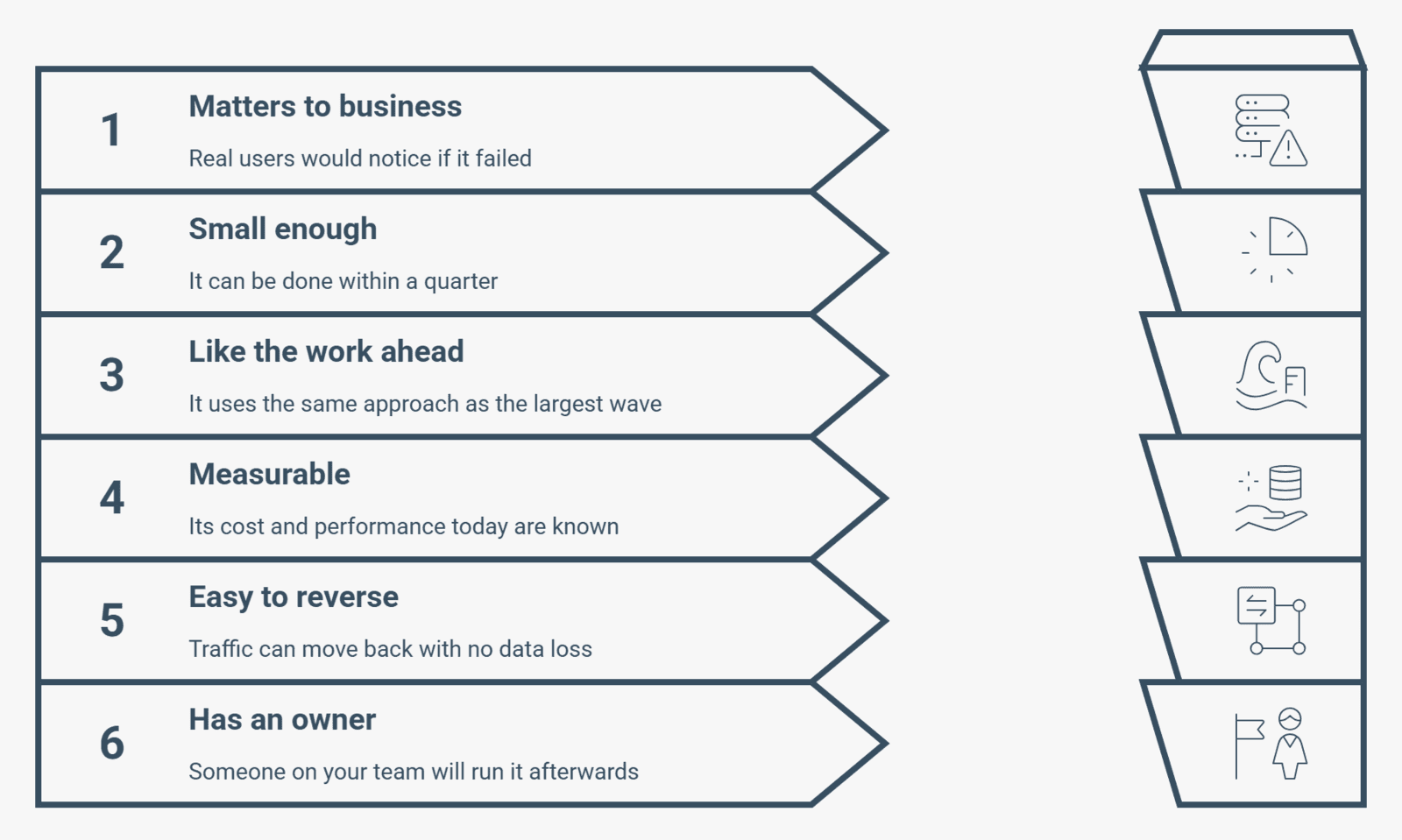
How the work actually runs
Both tiers are fixed price. Tier 3 is scoped once the design is agreed: one workload, one parallel run and one written recommendation. If the pilot turns up something the assessment missed, the recommendation says so and the plan for the remaining waves is updated.
Tier 2: design in three to five weeks
Tier 3: pilot fits within a time-frame
One senior consultant throughout
The consultant who makes the design decisions also builds on them during the pilot. If a choice doesn’t hold up under real traffic, the person who made it sees it first and records it in the recommendation, along with what to change.
What you walk away with
A design your team or any team can build from, and one workload that proves it. The pilot keeps running in production after Tier 3 ends, as the first part of your modernized system.
➖ Constraint register. What the design had to fit inside, from data residency to integrations and budget, and the reason behind each constraint.
➖ Decision records. Every significant choice, the options considered, the approach for each 6R verdict and what would trigger a rethink.
➖ Pilot in production. One workload live on the new architecture, with its deployment pipeline, monitoring and runbooks for everyday operation.
➖ Target architecture. Compute, data, identity, networking and monitoring for your applications, with the Azure environment specified and costed.
➖ Pilot charter. The workload chosen, the six checks it passed, how success will be measured and how long the parallel run will last.
➖ Go/no-go memo. Actual cost, performance and effort against the estimate, and a clear recommendation for every wave still to come.
Our Way
The constraints are written down first, and the design is built to fit inside them. The pilot is then chosen to test the most demanding pattern your remaining waves will use, so what it proves carries over to the work that follows.
Every decision is recorded with the options considered and the reason one was chosen. When someone asks in two years why the system was built this way, the answer is on record, and your team can judge whether it still holds.
A modernized application can still age badly if the architecture underneath it is wrong. The design has to suit how your business works today and leave room for where it is going, including AI features that aren’t on the roadmap yet.
Questions clients typically ask
Ready to move?
Let's talk about where you are and where you want to go. and whether modernization is even the right answer this year. If it is not, you will hear that.