
Where this actually breaks
Support has ended underneath your applications
Several applications run on .NET Framework and Windows Server versions that no longer get security patches. An auditor or a customer has flagged it. Nobody can yet say how many applications are affected or what upgrading each one involves.
The .NET upgrade stalled at the first dependency
The team tried moving one application. It stopped at a WCF service other systems call, a reporting component with no modern version and a shared library tied to .NET Framework. Nobody knows how many other applications have the same blockers.
Every release puts the business at risk
Deployments are manual and done out of hours, and something breaks often enough that releases have slowed to once a month. A change to one application breaks another, because they share a database and stored procedures nobody has mapped.
AI can't reach the data it needs
The AI use case is approved, but the data sits in SQL Server behind stored procedures called from WebForms code-behind. There's no API to call and no clean data model. Every AI pilot starts with rebuilding part of the application, and nobody has costed that yet.
Six steps from inventory to roadmap
Steps 1 to 3 are the Legacy Health Check (Tier 0), where every application gets a ModernityScore™. Steps 4 to 6 are the Modernization Roadmap (Tier 1). Each step ends with a written output, and the next step builds on it
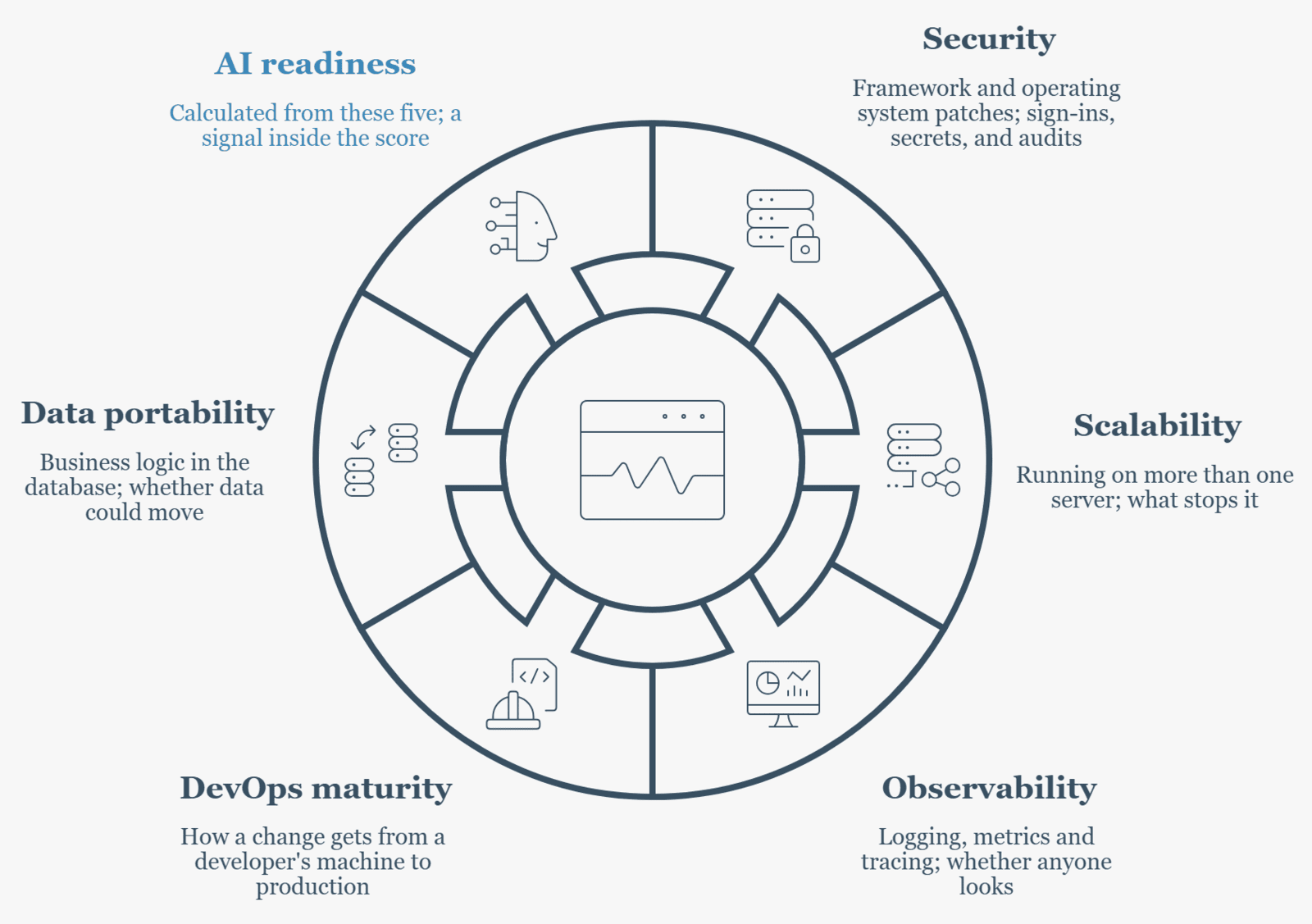
The five dimensions
Security. Whether the framework and operating system still get patches, how users and services sign in, where secrets are kept, and what an audit would flag first.
Scalability. Whether the application can run on more than one server, and what stops it: session state in memory, files on a local disk, or a scheduled job that assumes a single machine.
Observability. Whether you'd know it had failed before a user told you. Logging, metrics and tracing, and whether anyone actually looks at them.
DevOps maturity. How a change gets from a developer's machine to production, how long that takes, and how much depends on someone following a document by hand.
Data portability. How much business logic lives in the database, how tied the schema is to other systems, and whether the data could move without the application.
AI readiness is calculated from these five. It's reported as a signal inside the score, because an application that isn't healthy can't support AI features reliably.
How the work actually runs
Both tiers are fixed price, agreed up front from the number of applications and integrations in scope. You’ll know the price and the timeline before any work starts, and you can stop after Tier 0.
Tier 0 takes one to two weeks
Tier 1 follows straight on
One senior consultant throughout
The consultant who reads your code and stored procedures is the one who presents the roadmap to your leadership. Nothing gets lost between the person who did the analysis and the person who wrote the summary, and you have one person to hold accountable for the numbers.
What you walk away with
Everything is yours to keep and use with any delivery partner, including one that isn’t us. The roadmap is written so that anyone can carry it out.
➖ Dependency map. Every application, integration, scheduled job and shared database, and what breaks downstream if any one of them stops.
➖ Findings report. The risks that matter most across your applications: what’s out of support, what blocks an upgrade and what fails first.
➖ Costed wave plan. Applications grouped into delivery waves by dependency and risk, each wave with a cost range and the assumptions behind it.
➖ Modernity Score. One per application, with a score on each of the five dimensions, the evidence behind each score and what would raise it.
➖ 6R verdict register. A verdict for each application with its reasoning, the option we rejected and a date to revisit anything left as it is.
➖ Leadership summary. What you have, what’s at risk, what moving costs and the order to do it in, written in plain language for every stakeholder.
Our Way
Each verdict is then weighed against the whole portfolio. An application can score poorly and still be the right one to leave alone, because nothing depends on it and nothing about it needs to change. Another can score well and still need to move first, because three others are waiting on it.
We’re comfortable with a quiet result. If most of your applications should stay as they are, the assessment has done its job, and you’ve learned that in a few weeks for a fixed price. The roadmap is written so your own team or any partner can deliver it.
The most useful thing an assessment can give you is confidence in your next decision. I’d rather tell you that most of your applications are fine for another two years than recommend work you don’t need.
Questions clients typically ask
Ready to move?
Let's talk about where you are and where you want to go. and whether modernization is even the right answer this year. If it is not, you will hear that.