
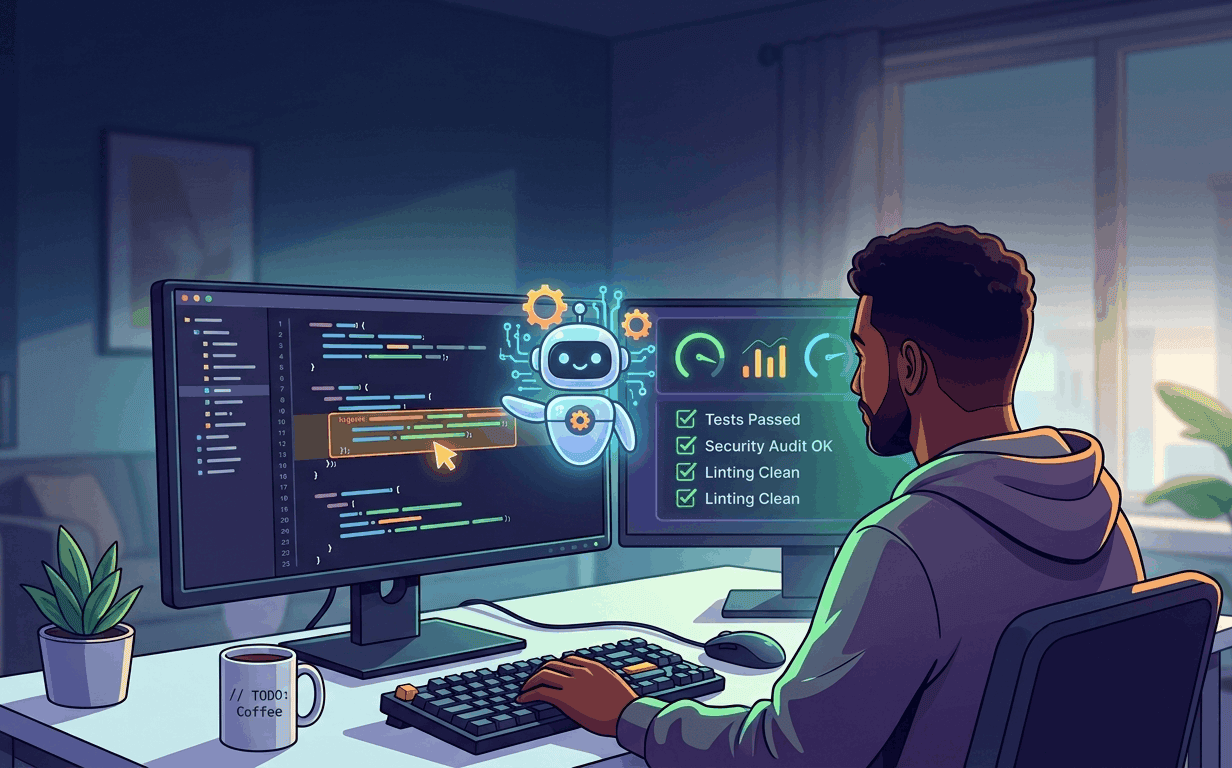
Before the AI era, functional was often the finish line.
Deadlines were aggressive. Coding was laborious. Sponsors rarely cared whether every HTTP response code was handled or every meaningful event was logged. They cared that the feature worked.
Ship it!
That mindset quietly became the norm. Not because engineers didn't know better, but because there was rarely enough time or budget to justify doing the extra work properly.
AI is changing that equation. For the first time, we have the bandwidth to pursue a level of quality that was routinely sacrificed to deadlines. This is one of the most underrated shifts happening in software engineering right now, and it deserves far more attention.
AI-Assisted Isn't Vibe Coding. It's Leverage.
Here's the distinction that matters: AI-assisted development isn't about typing a vague prompt and accepting whatever comes back.
It's a superpower, but only in the hands of someone who already knows what good code looks like.
Give the same tool to two engineers, and you'll get two very different outcomes. The tool amplifies judgment; it doesn't replace it.
A few examples illustrate what this looks like in practice.
1. Infrastructure as Code
Traditionally, IaC has often been seen as expensive to adopt. Writing and maintaining Terraform modules properly takes time that most teams feel they don't have. So they resort to manual provisioning or console clicks, quietly accumulating technical debt.
AI removes a significant part of that upfront effort. An engineer who understands state management, least-privilege IAM, and environment isolation can now generate a well-structured module, complete with tagging standards and environment separation, in a fraction of the time it once took.
What was previously treated as a nice to have is becoming much more practical as a default practice.
2. Input Validation
It takes seconds to generate a function that works for the happy path. It takes engineering judgment to insist that every parameter is checked for null values, type, range, and boundary conditions before it touches production data.
AI can generate that validation logic almost instantly. But someone still needs to know what to validate, which assumptions are unsafe, and where things are likely to go wrong.
3. API Error Handling
A working demo handles the 200. A resilient system also accounts for the 401, 403, 404, 429, and 500, with appropriate handling for authentication failures, missing resources, rate limits, and server errors.
AI can generate much of this handling in minutes. The engineer's job is to ensure that each scenario gets the right treatment, whether that's a retry, a fallback, a meaningful error response, or an alert.
The real advantage comes from knowing these scenarios matter before they become production incidents.
4. Test Coverage
Thorough unit tests and edge-case testing have always been among the first things to get cut when timelines tighten.
AI makes generating meaningful test cases, including the awkward edge cases nobody wants to think through, far less laborious.
The excuse of "we didn't have time to test that path" is becoming harder to justify.
5. Documentation
Nobody enjoys writing documentation, and it often starts drifting out of sync the moment priorities shift.
AI can generate documentation alongside the code and help keep it updated as the implementation evolves. The effort required to produce and maintain it has dropped significantly, making stale documentation less excusable than it once was.
Of course, generated documentation still needs to be verified against the actual implementation. Lowering the cost of writing it doesn't eliminate the responsibility to keep it accurate.
The Real Skill Hasn't Changed
None of this is new knowledge.
Good engineers have always known what separates functional code from production-grade software. What's new is that we finally have the leverage to build more of that quality into our systems without blowing the timeline.
So the real skill in this AI era isn't prompting. It's knowing what good actually looks like, understanding where systems can fail, and being able to demand the right things from the tools at our disposal.
AI isn't replacing the engineer who understands quality. It's finally giving that engineer more room to build it.