
For the past decade, cloud operations has largely been about managing scale: more infrastructure, more services, more dashboards, more alerts. We built bigger teams, layered on more tooling, and hired our way through the complexity. It worked; until it didn't.
AI workloads and modern applications are changing the rules. Environments now shift from experimentation to full production in weeks. Infrastructure is continuously updated, scaled, and reconfigured. Telemetry streams from every layer; health, configuration, cost, performance, security, faster than any team can meaningfully process. The reality is that traditional operations simply weren't designed for this level of speed and interconnectedness.
So what's the answer? I believe it's a fundamental shift in the operating model itself.
From Reactive to Agentic
What's emerging is what Microsoft is callingagentic cloud operationsand it's worth paying close attention to, because the concept goes well beyond another AI feature or dashboard upgrade.
The idea is this: rather than humans manually correlating signals and triaging issues, AI-powered agents are embedded directly into the operational workflow. They don't just surface insights, they translate them into coordinated, governed action across the full cloud lifecycle.
Microsoft'sAzure Copilotis the interface bringing this to life. It's not a bolt-on chatbot. It's a unified environment grounded in your actual Azure setup, your subscriptions, resources, policies, and operational history, accessible through natural language, chat, console, or CLI. And it's backed by a suite of agents built for every phase of the cloud lifecycle.
What the Agents Actually Do
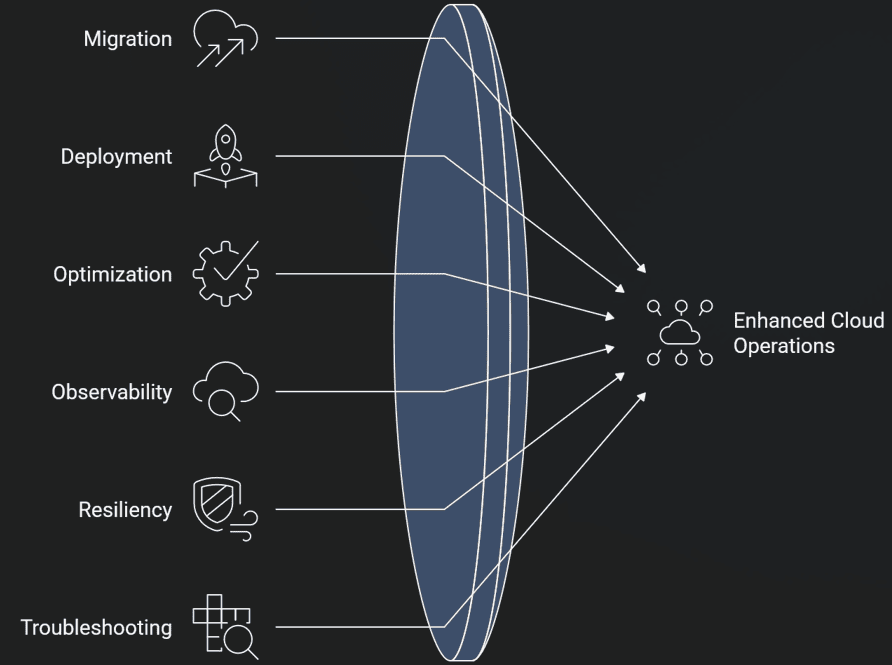
This is where it gets practical. The agentic capabilities span six key operational domains:
Migration: Discovers existing environments, maps dependencies, and identifies modernization paths before anything moves. Later in the lifecycle, it re-enters to identify opportunities for continuous refactoring — making modernization an ongoing practice, not a one-time project.
Deployment: Guides well-architected design, generates infrastructure-as-code, and supports governed, repeatable deployment workflows that validate both infrastructure and application rollout before you go live.
Observability: Establishes baseline health from the moment production traffic hits and provides continuous, full-stack visibility and diagnosis across applications and infrastructure in ongoing operations.
Resiliency: Identifies gaps across availability, recovery, backup, and continuity upfront. In ongoing ops, it shifts to proactive posture management, continuously strengthening protection against risks like ransomware, not just validating configurations after the fact.
Optimization: Identifies and executes improvements across cost, performance, and sustainability. Notably, it can compare financial and carbon impact in real time, a capability that's increasingly relevant as organizations manage both FinOps and sustainability commitments.
Troubleshooting: Accelerates issue resolution by diagnosing root causes, recommending fixes, and initiating support actions. The goal is to move teams from reactive firefighting to rapid, context-aware incident resolution.
What matters here is that these agents don't operate in isolation. They work as a connected, context-aware system, correlating real-time signals, understanding operational context, and taking governed action where it matters most.
Governance Is Not an Afterthought
For anyone leading technology in a regulated or mission-critical environment, the governance story matters just as much as the capability story. This is a point I always push teams on when evaluating agentic tooling.
Azure's approach embeds governance at every layer. Every agent-initiated action honors existing policy, security, and RBAC controls. Actions are reviewable, traceable, and auditable. There are also features like Bring Your Own Storage for conversation history, keeping operational data within your own Azure environment for sovereignty and compliance.
The framing here is important: autonomy and safety advancing together. Human oversight isn't removed from automated workflows, it's designed to remain central to them.
My Take: Why This Matters Now
I've seen a lot of "AI for operations" announcements over the years. Most have been incremental, smarter alerting, better anomaly detection, assisted root cause analysis. Useful, but not transformative.
What's different about the agentic model is that it closes the loop. Insight becomes execution. The system doesn't just tell you there's a problem or an opportunity, it takes action within the boundaries you've defined. That's a meaningful step forward.
The organizations that will benefit most from this shift are those that start building the right operational habits now: defining clear governance boundaries, investing in observability foundations, and treating AI agents as genuine operational partners rather than novelty tools.
The cloud is getting more dynamic, not less. Our operating models need to evolve to match it.